
Dive Explorer
-
Witamy na kursie Dive Explorer!
-
Nurkowanie wysokogórskie
Wprowadzenie do nurkowania przygodowego na wysokości -
Planowanie nurkowań wysokościowych
-
Jak wysokość wpływa na nurków
-
Sprawdzenie wiedzy na temat nurkowania przygodowego na wysokości1 Quiz
-
Altitude Adventure Dive
-
Nurkowanie łodzią przygodowąWprowadzenie do nurkowania przygodowego na łodzi
-
Łodzie, terminy i typy
-
Zasady ruchu drogowego i świadomość żeglarska
-
Sprawdzenie wiedzy z nurkowania na łodzi1 Quiz
-
Nurkowanie łodzią przygodową
-
Nurkowanie z wypornościąWprowadzenie do nurkowania z wypornością
-
Osiągnięcie neutralnej pływalności – sztuka nieważkości pod wodą
-
Zaawansowane umiejętności pływalności – podnieś poziom swojego nurkowania
-
Sprawdzenie wiedzy z nurkowania z pływalnością1 Quiz
-
Nurkowanie z wypornością
-
Głębokie nurkowanie przygodoweWprowadzenie do nurkowania Deep Adventure
-
Przygotowanie do nurkowania na głębokość
-
Głębokie planowanie nurkowania
-
Sprawdzenie wiedzy z nurkowania Deep Adventure1 Quiz
-
Głębokie nurkowanie przygodowe
-
Nurkowanie przygodowe DPVWprowadzenie do nurkowania przygodowego z pojazdami z napędem nurkowym (DPV)
-
Bezpieczeństwo i zarządzanie kryzysowe DPV
-
Sprawdzenie wiedzy z nurkowania DPV Adventure1 Quiz
-
Nurkowanie przygodowe DPV
-
Nurkowanie z dryfuWprowadzenie do nurkowania Drift Adventure
-
Procedury bezpieczeństwa dla nurkowania dryfowego
-
Techniki nurkowania dryfowego
-
Sprawdzenie wiedzy z nurkowania Drift Adventure1 Quiz
-
Nurkowanie z dryfu
-
Nurkowanie przygodowe w suchym skafandrzeWprowadzenie do nurkowania przygodowego w suchym skafandrze
-
Nurkowanie w suchym skafandrze
-
Procedury bezpieczeństwa i awaryjne dotyczące suchego skafandra
-
Sprawdzenie wiedzy o nurkowaniu w suchym skafandrze1 Quiz
-
Sesja nurkowania w suchym skafandrze na wodach zamkniętych
-
Nurkowanie przygodowe w suchym skafandrze
-
Nurkowanie przygodowe z ekologią morskąWprowadzenie do nurkowania przygodowego z ekologią morską
-
Grupowanie organizmów i role funkcjonalne
-
Relacje, interakcje i zachowania
-
Sprawdzenie wiedzy z nurkowania przygodowego z ekologii morskiej1 Quiz
-
Nurkowanie przygodowe z ekologią morską
-
Multimedialna przygoda nurkowaWprowadzenie do nurkowania multimedialnego
-
Podstawy GoPro
-
Dbanie o środowisko, siebie i swój sprzęt
-
Multimedialna Przygoda Nurkowanie Sprawdzenie Wiedzy1 Quiz
-
Multimedialna przygoda nurkowa
-
Nurkowanie z nawigacjąWprowadzenie do nurkowania przygodowego nawigacyjnego
-
Podstawy nawigacji podwodnej
-
Zaawansowane techniki kompasu
-
Nawigacja Przygoda Nurkowanie Sprawdzenie Wiedzy1 Quiz
-
Nurkowanie z nawigacją
-
Nocne nurkowanie przygodoweWprowadzenie do nurkowania nocnego
-
Przygotowanie do nurkowania nocnego
-
Techniki nurkowania nocnego
-
Sprawdzenie wiedzy z nurkowania nocnego1 Quiz
-
Nocne nurkowanie przygodowe
-
Nurkowanie przygodowe z nitroksemWprowadzenie do nurkowania przygodowego na Nitroxie
-
Podstawy nurkowania na nitroksie
-
Rozważania dotyczące nurkowania z nitroksem
-
Sprawdzenie wiedzy na temat nurkowania Nitrox Adventure1 Quiz
-
Nurkowanie przygodowe z nitroksem
-
Nurkowanie poszukiwawczo-odzyskoweWprowadzenie do nurkowania poszukiwawczo-odzyskowego
-
Planowanie i wykonywanie wzorców wyszukiwania
-
Korzystanie ze specjalistycznego sprzętu
-
Sprawdzenie wiedzy z zakresu nurkowania poszukiwawczo-odzyskowego1 Quiz
-
Nurkowanie poszukiwawczo-odzyskowe
-
SMB Adventure DiveWprowadzenie do nurkowania przygodowego SMB
-
Przygotowanie do sukcesu: sprzęt SMB i jego montaż
-
Wypuszczanie SMB pod wodą
-
Sprawdzenie wiedzy – SMB Adventure Dive1 Quiz
-
SMB Adventure Dive
-
Nurkowanie wrakoweWprowadzenie do nurkowania wrakowego
-
Zapobieganie sytuacjom awaryjnym i procedury nurkowania na wrakach
-
Planowanie i przygotowanie
-
Sprawdzenie wiedzy na temat nurkowania wrakowego1 Quiz
-
Nurkowanie wrakowe
Głębokie planowanie nurkowania
Głębokie planowanie nurkowania
Do końca tej lekcji będziesz potrafił:
- Explain how to plan deep dives
- Calculate your surface air consumption rate
Planning is a pivotal aspect of deep diving, where meticulous preparation and knowledge are key to a safe and successful dive. In this section, we’ll explore the essentials of deep dive planning, focusing on critical aspects such as gas management.
How to Plan Deep Dives
Objective Setting
Define the purpose of your dive (e.g., exploration, photography, wreck diving). This will guide the specifics of your plan, including depth, duration, and special equipment needs.
Depth and Time Management
Plan your maximum depth and bottom time. Adhere to limits based on your certification level, experience, and comfort. Use a dive computer to determine safe ascent profiles and necessary no-decompression dive limits.
Gas Management
Calculating Air Consumption: Calculate your Surface Air Consumption (SAC) rate to estimate your needed gas. Consider factors like depth, exertion level, and water temperature.
Gas Reserve Planning: Always plan to surface with a reserve, often a third of your starting gas supply.
Dive Team Coordination
Coordinate with your dive team. Ensure everyone understands the plan, including depth, time, and emergency procedures.
Equipment Check
Ensure all equipment is suited for deep diving and in good working condition. This includes redundancy systems like a backup regulator and an alternate air source.
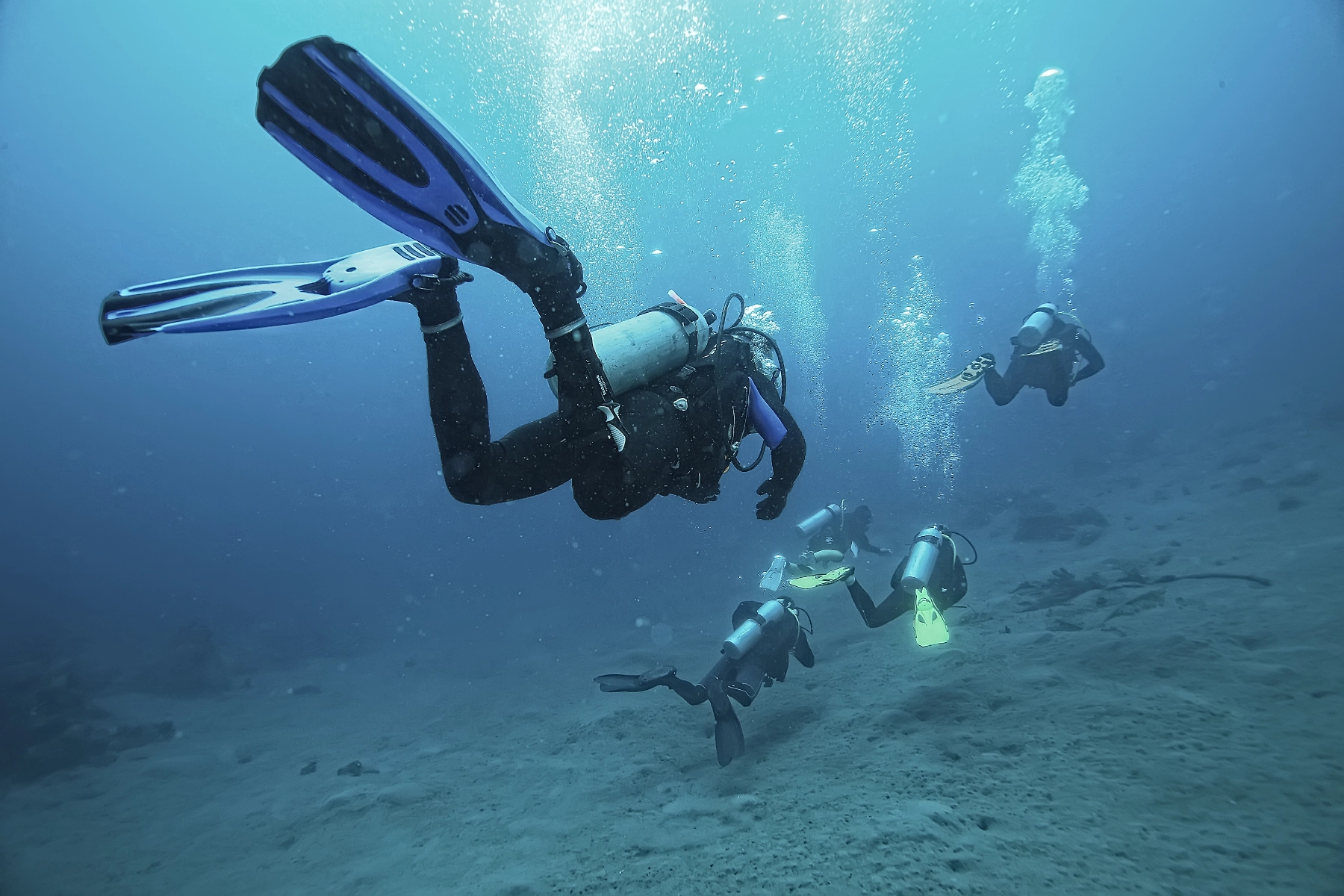
Calculating your Surface Air Consumption (SAC) rate
Calculating your Surface Air Consumption (SAC) rate is an essential skill for any diver, especially when planning for deep dives. The SAC rate measures your air consumption at the surface, which can be used to estimate how much air you’ll use during a dive at depth. Here’s how to calculate it:
Step 1
Record Your Dive Information
Starting and Ending Tank Pressure: Note the pressure in your tank at the beginning and end of the dive. This should be in Bar.
Dive Time: Record the total time of your dive in minutes, from descent to ascent.
Step 2
Calculate Air Used
Subtract the ending tank pressure from the starting pressure to determine how much air (in bar) you’ve used during the dive.
Step 3
Adjust for Tank Size
Multiply the amount of air used by the tank volume. This gives you the air used in litres.
Step 4
Convert to Surface Consumption
- To adjust for depth, you need to factor in the pressure at the depth of your dive. Use the average depth of your dive in meters.
- Convert this average depth to an absolute pressure. Add 1 bar for every 10 meters of depth,
- Add the atmospheric pressure (1 bar) to the depth pressure to get the absolute pressure.
Step 5
Calculate the SAC Rate
Divide the total air used (from step 3) by the dive time (in minutes) and then by the absolute pressure (from step 4). This gives you the SAC rate in liters per minute at surface pressure.
Now that you know the steps to calculate your SAC, let’s work through an example:
- Air Used: 200 bar – 150 bar = 50 bar
- Total Air Used in Litres: 50 bar × 12 litres = 600 litres
- Absolute Pressure at 20 meters: 2 bar (for the depth) + 1 bar (atmospheric pressure) = 3 bar
- SAC Rate: 600 litres ÷ 40 minutes ÷ 3 bar = 5 litres per minute
This means your SAC rate is 5 litres per minute at surface pressure. Knowing this rate helps you estimate how much air you’ll need for a dive at a given depth, which is crucial for deep dive planning and gas management.
Using Your SAC Rate
To use your Surface Air Consumption (SAC) rate for planning a dive at a different depth, like 30 meters, you’ll follow a series of steps to adjust the rate for the increased pressure at the new depth. Here’s how to do it:
Step 1
Calculate Absolute Pressure at the Planned Depth
Determine the total pressure at your planned depth. For every 10 meters of depth in salt water, add 1 bar to account for the pressure exerted by the water. Don’t forget to include the atmospheric pressure at the surface, which is 1 bar.
Step 2
Adjust SAC Rate for Planned Depth
Multiply your surface SAC rate by the total pressure at the planned depth. This gives you your air consumption rate at that depth.
Step 3
Estimate Total Air Consumption for the Dive
To estimate how much air you’ll use during the dive, multiply the adjusted SAC rate by the total bottom time of your dive at depth.
Step 4
Include Ascent and Safety Stop
Remember to factor in air consumption for your ascent and any safety stops. These are at shallower depths, so the rate will be different from the bottom time consumption rate.
Step 5
Plan for Reserves
Always plan to have a reserve amount of air for emergencies. A common rule is to end your dive with at least a third of your starting air supply.
Calculating the amount of gas you will use at depth ensures you have sufficient gas for the dive and enough reserve in case of emergencies.
Example Calculation
Suppose your SAC rate is 5 litres per minute at surface pressure. You’re planning a dive to 30 meters. Here’s how you apply the steps:
- Absolute Pressure at 30 Metres: At 30 meters depth in saltwater: 3 bar (from water pressure) + 1 bar (atmospheric pressure) = 4 bar.
- Adjust SAC Rate for 30 Metres: Your adjusted SAC rate at 30 meters: 5 litres per minute (surface SAC rate) × 4 bar (absolute pressure) = 20 litres per minute.
- Estimate Total Air Consumption: If you plan to be at 30 meters for 20 minutes, 20 litres per minute × 20 minutes = 400 litres.
- Account for Ascent and Safety Stops: Estimate additional air needed for ascent and safety stops. If, say, you’ll spend 5 minutes ascending and at safety stops where the average pressure is 2 bar: 5 litres per minute (surface SAC rate) × 2 bar × 5 minutes = 50 litres.
This example shows how you can use your SAC rate to plan for air consumption on a dive at 30 meters, ensuring you have enough air for the entire dive, including reserves for safety.
How many litres of gas are in your tank?
To calculate the total amount of gas tank filled, multiply the tank volume by the pressure in bar.
For example, to calculate the total amount of gas in a 12-litre tank filled to 200 bar, you multiply the tank volume by the pressure. In this case, the tank volume is 12 litres, and the pressure is 200 bar. The formula is:
Total Gas Volume = Tank Volume x Pressure
So for your tank:
Total Gas Volume = 12 litres x 200 bar = 2400 litres
A 12-litre tank filled to 200 bar contains 2400 litres of gas. This is calculated by multiplying the tank volume (12 litres) by the pressure (200 bar).
So a 12-litre tank would be sufficient for our requirements of 450 litres of gas for the dive and would provide plenty of backup gas.