
Open Water Diver
-
Welcome to your Open Water Diver Course
-
Adapting to the Underwater World
-
Your Equipment
-
Keeping Warm Underwater
-
Communicating Underwater
-
Buoyancy
-
The Diving Environment
-
The Buddy System
-
Considerations for Diving
-
Equipment and Accessories
-
Diving Techniques
-
Health for Diving
-
Dive Computers
-
Additional Dive Accessories
-
Open Water Diver Final Exam1 Quiz
-
Before you go Diving
-
Open Water Diver Confined Water Training Dive 1
-
Open Water Diver Confined Water Training Dive 2
-
Open Water Diver Confined Water Training Dive 3
-
Open Water Diver Confined Water Training Dive 4
-
Open Water Diver Confined Water Training Dive 5
-
Open Water Diver Training Dive 1
-
Open Water Diver Training Dive 2
-
Open Water Diver Training Dive 3
-
Open Water Diver Training Dive 4
Adapting to the Underwater World
Adapting to the Underwater World
By the end of this lesson, you will understand:
What is the most important rule in scuba diving
- How to equalise your airspaces underwater
Breathing Underwater
You’ll soon be entering a wonderful new world and taking your first breaths underwater. So what should you expect? Just like on land, it’s important to keep breathing and never hold your breath. In fact, that’s the most crucial rule in scuba diving.
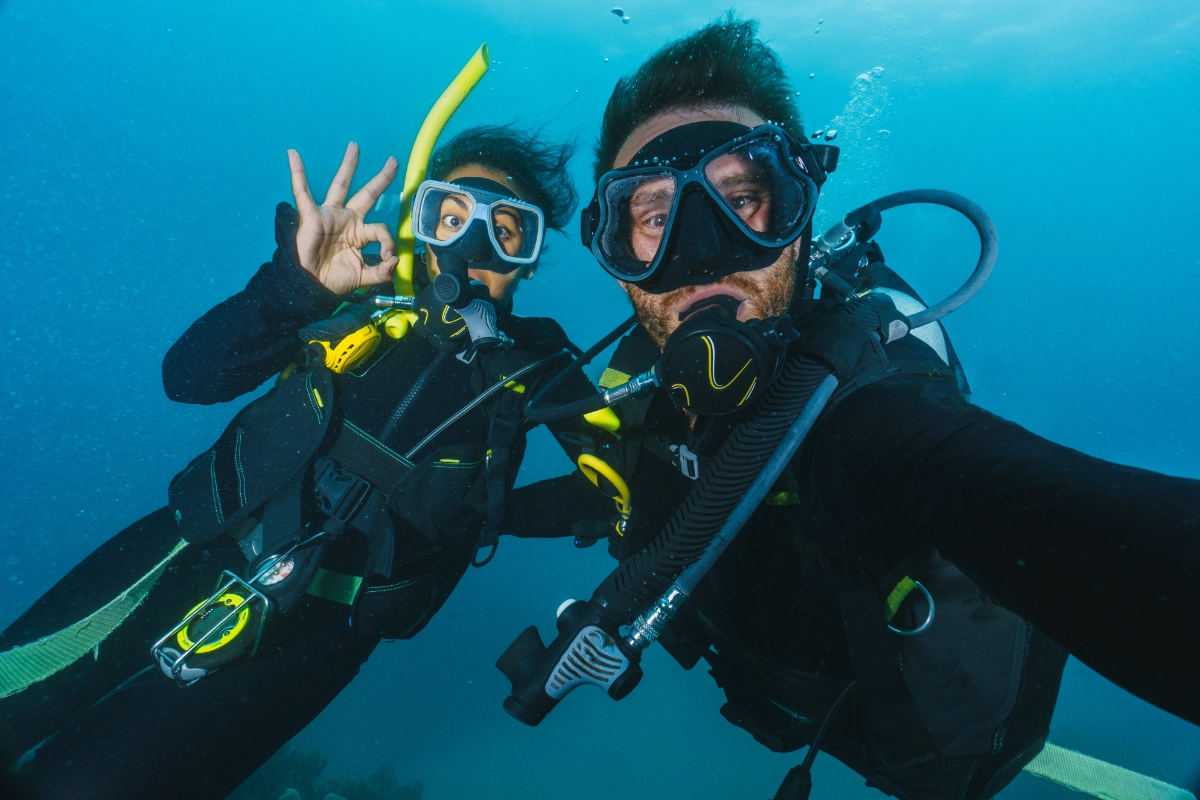
How your airspaces are affected underwater
Water has weight, which adds to the pressure on your body. The deeper you go underwater, the greater the pressure exerted on your body. As your body is 60% water, you will feel the most significant impact of this increased pressure on your air spaces, such as your lungs, ears and sinuses.
Effects of Pressure on your airspace
When diving, changes in water pressure can impact your airspaces. As you descend, the pressure increases and as you ascend, it decreases. This in turn affects the volume of the airspaces in your body. The air in your airspaces will be compressed as you descend and the pressure increases. Conversely, as you ascend and the pressure decreases, this air will expand.
How do you deal with pressure changes underwater?
As you descend underwater, you’ll need to equalise the air in your body. To do this, you simply need to remember the most important rule in scuba diving – Keep Breathing and Never Hold Your Breath
You will also need to equalise your sinuses and ears using one of the techniques below.
Method 1 - Valsalva Manoeuvre
Method 2 - Toynbee Manoeuvre
- Gently pinch your nose
- Continue pinching your nose
- Blow gently through your nose until the pressure subsides.
- Gently pinch your nose
- Continue pinching your nose and swallow until the pressure subsides
Equalising Your Airspaces
As you descend, pressure increases, making it harder for the Eustachian tubes to open and equalise the pressure between the outer and middle ear. Standard techniques for equalising include the Valsalva Manoeuvre, which involves exhaling against a closed mouth and nose, and the Toynbee Manoeuvre, which involves swallowing while holding your nose. These techniques help to open the Eustachian tubes, allowing the pressure to equalise. You should equalize ever meter while descending.
How Deep Can You Go Underwater?
The maximum depth for recreational diving is 40 metres. Only divers with a Deep Diver speciality should go that deep. You maximum depth depends on your level of training:
- 12 metres for Intro to Scuba participants and certified Guided Divers. Dives should only be made under the direct supervision of a Diving Professional.
- 18 metres for certified Open Water Divers
- 30 metres for certified Dive Explorers
- 40 metres for certified Deep Divers
 English (Metric)
  English (US Units)
  العربية
  简体中文
简体中文  Français
  Nederlands
  Deutsch
  हिन्दी
  Bahasa Indonesia
  Italiano
  Norsk bokmål
  فارسی
فارسی  Español
  ไทย
ไทย  한국어
한국어  Polski