
Deep Diver
-
Introduction to Deep Diving
-
Preparing for Deep Diving
-
Deep Dive Planning
-
Deep Diving Techniques
-
Equipment for Deep Diving
-
Advanced Buoyancy Control
-
Conservation Awareness for Deep Diving
-
Deep Diver Exam1 Quiz
-
Before you go Diving
-
Deep Diver Training Dive 1
-
Deep Diver Training Dive 2
-
Deep Diver Training Dive 3
-
Deep Diver Training Dive 4
Deep Dive Planning
By the end of this lesson, you will be able to:
- Explain how to plan deep dives
- Calculate your surface air consumption rate
Planning is a pivotal aspect of deep diving, where meticulous preparation and knowledge are key to a safe and successful dive. In this section, we’ll explore the essentials of deep dive planning, focusing on critical aspects such as gas management.
How to Plan Deep Dives
Objective Setting
Define the purpose of your dive (e.g., exploration, photography, wreck diving). This will guide the specifics of your plan, including depth, duration, and special equipment needs.
Depth and Time Management
Plan your maximum depth and bottom time. Adhere to limits based on your certification level, experience, and comfort. Use a dive computer to determine safe ascent profiles and necessary no-decompression dive limits.
Gas Management
Calculating Air Consumption: Calculate your Surface Air Consumption (SAC) rate to estimate your needed gas. Consider factors like depth, exertion level, and water temperature.
Gas Reserve Planning: Always plan to surface with a reserve, often a third of your starting gas supply.
Dive Team Coordination
Coordinate with your dive team. Ensure everyone understands the plan, including depth, time, and emergency procedures.
Equipment Check
Ensure all equipment is suited for deep diving and in good working condition. This includes redundancy systems like a backup regulator and an alternate air source.
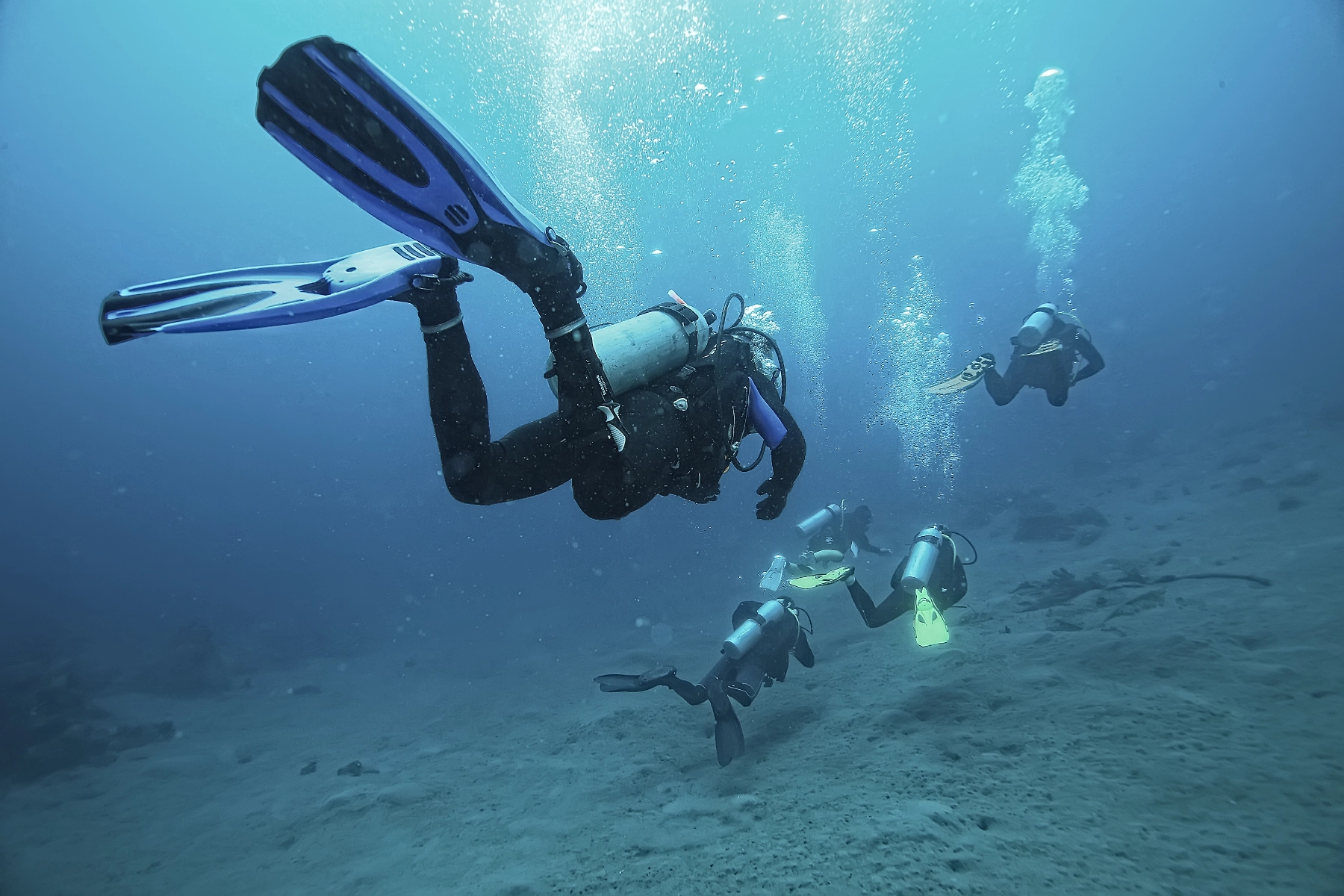
Calculating your Surface Air Consumption (SAC) rate
Calculating your Surface Air Consumption (SAC) rate is an essential skill for any diver, especially when planning for deep dives. The SAC rate measures your air consumption at the surface, which can be used to estimate how much air you’ll use during a dive at depth. Here’s how to calculate it:
Step 1
Record Your Dive Information
Starting and Ending Tank Pressure: Note the pressure in your tank at the beginning and end of the dive. This should be in PSI.
Dive Time: Record the total time of your dive in minutes, from descent to ascent.
Step 2
Calculate Air Used
Subtract the ending tank pressure from the starting pressure to determine how much air (in PSI) you’ve used during the dive.
Step 3
Adjust for Tank Size
Multiply the amount of air used by the tank volume. This gives you the air used in litres.
Step 4
Convert to Surface Consumption
- To adjust for depth, you need to factor in the pressure at the depth of your dive. Use the average depth of your dive in feet.
- Convert this average depth to an absolute pressure. Add 1 bar for every 33 feet of depth,
- Add the atmospheric pressure (1 bar) to the depth pressure to get the absolute pressure.
Step 5
Calculate the SAC Rate
Divide the total air used (from step 3) by the dive time (in minutes) and then by the absolute pressure (from step 4). This gives you the SAC rate in liters per minute at surface pressure.
Now that you know the steps to calculate your SAC, let’s work through an example:
- Air Used: 200 bar – 150 bar = 50 bar
- Total Air Used in Litres: 50 bar × 12 litres = 600 litres
- Absolute Pressure at 66 feet: 2 bar (for the depth) + 1 bar (atmospheric pressure) = 3 bar
- SAC Rate: 600 litres ÷ 40 minutes ÷ 3 bar = 5 litres per minute
This means your SAC rate is 5 litres per minute at surface pressure. Knowing this rate helps you estimate how much air you’ll need for a dive at a given depth, which is crucial for deep dive planning and gas management.
Using Your SAC Rate
To use your Surface Air Consumption (SAC) rate for planning a dive at a different depth, like 99 feet, you’ll follow a series of steps to adjust the rate for the increased pressure at the new depth. Here’s how to do it:
Step 1
Calculate Absolute Pressure at the Planned Depth
Determine the total pressure at your planned depth. For every 33 feet of depth in salt water, add 1 bar to account for the pressure exerted by the water. Don’t forget to include the atmospheric pressure at the surface, which is 1 bar.
Step 2
Adjust SAC Rate for Planned Depth
Multiply your surface SAC rate by the total pressure at the planned depth. This gives you your air consumption rate at that depth.
Step 3
Estimate Total Air Consumption for the Dive
To estimate how much air you’ll use during the dive, multiply the adjusted SAC rate by the total bottom time of your dive at depth.
Step 4
Include Ascent and Safety Stop
Remember to factor in air consumption for your ascent and any safety stops. These are at shallower depths, so the rate will be different from the bottom time consumption rate.
Step 5
Plan for Reserves
Always plan to have a reserve amount of air for emergencies. A common rule is to end your dive with at least a third of your starting air supply.
Calculating the amount of gas you will use at depth ensures you have sufficient gas for the dive and enough reserve in case of emergencies.
Example Calculation
Suppose your SAC rate is 5 litres per minute at surface pressure. You’re planning a dive to 99 feet. Here’s how you apply the steps:
- Absolute Pressure at 99 feet: At 30 meters depth in saltwater: 3 bar (from water pressure) + 1 bar (atmospheric pressure) = 4 bar.
- Adjust SAC Rate for 99 feet: Your adjusted SAC rate at 30 meters: 5 litres per minute (surface SAC rate) × 4 bar (absolute pressure) = 20 litres per minute.
- Estimate Total Air Consumption: If you plan to be at 30 meters for 20 minutes, 20 litres per minute × 20 minutes = 400 litres.
- Account for Ascent and Safety Stops: Estimate additional air needed for ascent and safety stops. If, say, you’ll spend 5 minutes ascending and at safety stops where the average pressure is 2 bar: 5 litres per minute (surface SAC rate) × 2 bar × 5 minutes = 50 litres.
This example shows how you can use your SAC rate to plan for air consumption on a dive at 99 feet, ensuring you have enough air for the entire dive, including reserves for safety.
How many litres of gas are in your tank?
To calculate the total amount of gas tank filled, multiply the tank volume by the pressure in PSI.
For example, to calculate the total amount of gas in a 12-litre tank filled to 200 bar, you multiply the tank volume by the pressure. In this case, the tank volume is 12 litres, and the pressure is 200 bar. The formula is:
Total Gas Volume = Tank Volume x Pressure
So for your tank:
Total Gas Volume = 12 litres x 200 bar = 2400 litres
A 12-litre tank filled to 200 bar contains 2400 litres of gas. This is calculated by multiplying the tank volume (12 litres) by the pressure (200 bar).
So a 12-litre tank would be sufficient for our requirements of 450 litres of gas for the dive and would provide plenty of backup gas.